.avif)


.jpg)

.jpg)

.avif)




.png)
Starting in October 2026, the Depository Trust Company (DTC), which custodies more than $114 trillion in securities, will let banks and brokers convert part of their holdings into tokens on the Canton Network. Three asset types qualify: US Treasuries, Russell 1000 stocks and ETFs that track the major indices. The SEC cleared the DTCC Tokenization Service in a no-action letter on December 11, 2025, and more than thirty firms, including J.P. Morgan, BlackRock, Goldman Sachs and Citadel Securities, ran the first live transactions on July 15, 2026. The shares themselves don't move. They stay at DTC, and DTC's own record remains the official book. What changes is how they can be used: tokenized Treasuries and stocks can be posted as collateral, lent or financed at any hour, weekends included. Canton is one of the networks carrying them because it is private by default and lets DTC limit transfers to registered, sanctions-screened wallets, which the SEC requires.
The Depository Trust Company custodies $114 trillion in securities. In October it starts issuing some of them as tokens on Canton. Here is what that means and why the network matters.
For fifty-three years the answer to "where are your shares" has been the same, and it is neither your broker nor the exchange. It is a single institution called The Depository Trust Company, created in 1973 to end the mess of Wall Street physically carrying paper certificates between offices. The fix was to stop moving them at all, hold nearly every US security in one place, and record who owns what as entries in a ledger. That arrangement never changed. DTC now custodies assets valued at over $114 trillion, covering securities from more than 150 countries and territories, and when you buy a share of any US company what you own is an entry in a chain of records that ends there.
In October, some of those entries start being written to a blockchain.
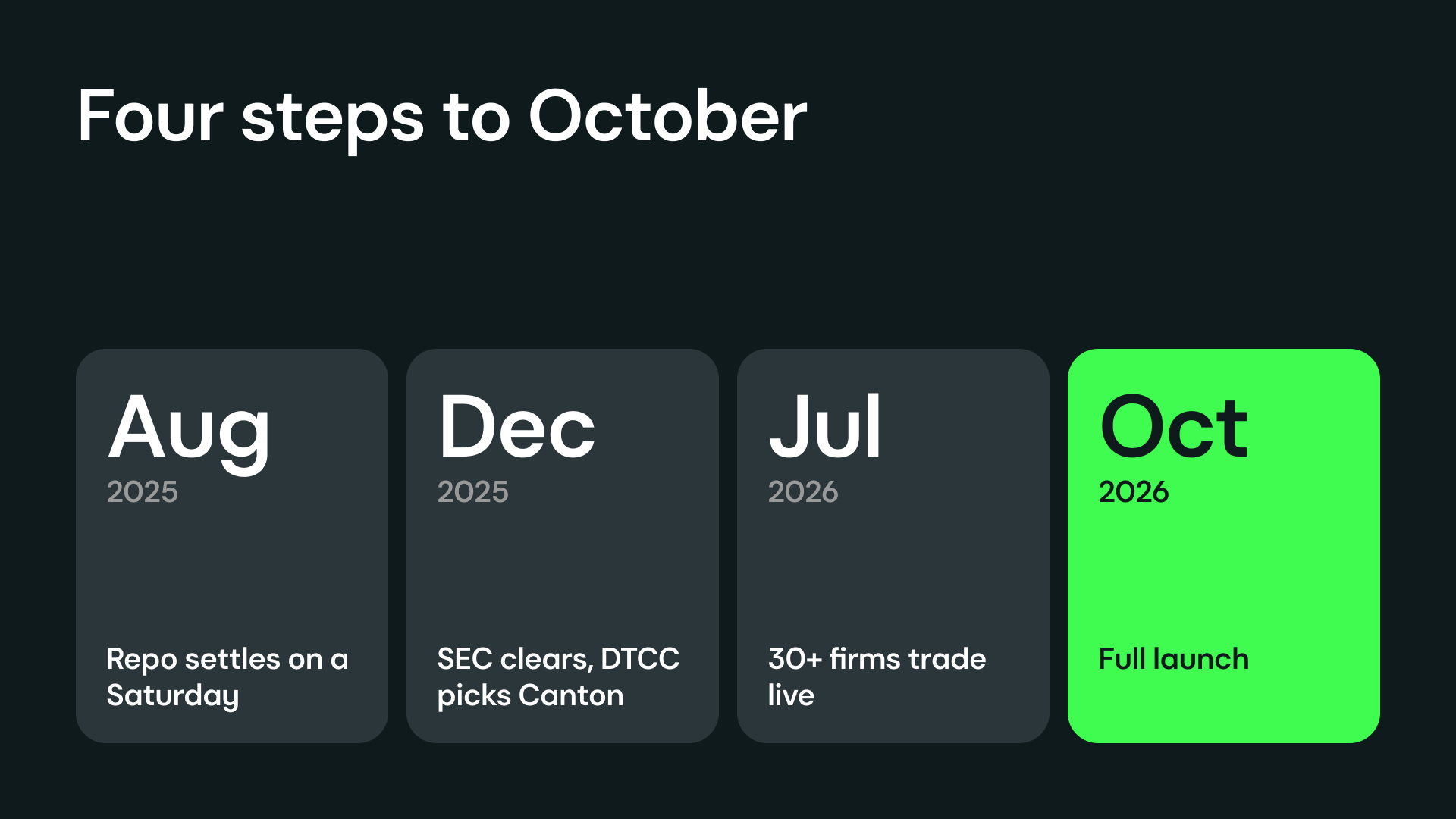
A bank or broker that already holds securities at DTC can ask for part of that position to be issued as tokens on a blockchain. Those tokens can then be moved, and later converted back into ordinary shares. Only three categories qualify: US Treasuries, the stocks in the Russell 1000, and ETFs tracking the major indices. The SEC cleared the service on December 11, 2025, in a no-action letter that runs three years from launch.
This has already run in production. On July 15, 2026, more than thirty firms took part in the first phase of live transactions, in which J.P. Morgan converted Invesco's QQQ into tokenized form and posted it as margin at CME, while Société Générale posted tokenized Treasuries as collateral with Citadel Securities. BlackRock, Vanguard, Goldman Sachs, Nasdaq and NYSE were among the participants. October is the full launch.
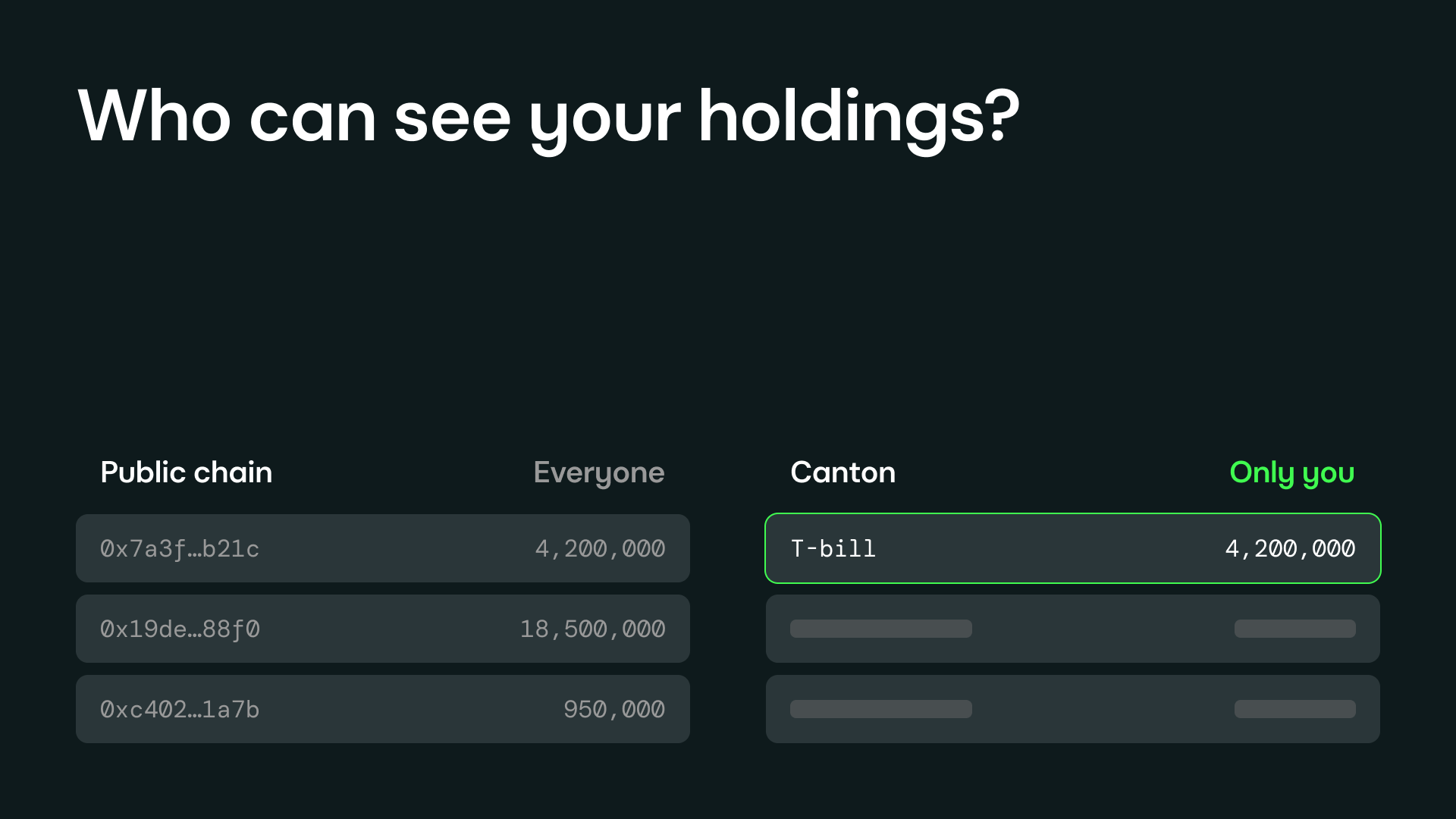
On a typical public chain, every balance sits in one table that anyone can read, and any address can receive a transfer. Neither of those works for what DTC is issuing. The no-action letter requires these tokens to move only to wallets DTC has registered and screened against sanctions lists, and a chain where any address can receive has no way to enforce that rule. Visibility is a separate problem: a firm's collateral and financing positions are competitive information, and a table the whole market can read would show what it holds and when it moves.
Canton is built the other way around. An asset there is a contract owned by a party, visible only to its stakeholders and the nodes hosting them, and the synchronizer that orders transactions sees encrypted envelopes rather than contents. Two banks can settle without the rest of the network learning the trade happened, let alone its size, because privacy is the ledger's default rather than something bolted on top.
The payoff for DTCC is that the constraints the SEC requires become properties the asset enforces itself. A token whose template says it may only move to a registered, OFAC-screened address refuses any other transfer at the ledger level. Canton's token standard, CIP-56, standardizes balances, transfers and atomic delivery-versus-payment while giving the issuer control over who can receive.
Canton is built by Digital Asset, a New York firm founded in 2014 and run by co-founder Yuval Rooz. It created Daml, the contract language Canton applications are written in, and Goldman Sachs was already using that language for its tokenized asset platform back in 2021. Digital Asset is also DTCC's implementation partner for the Tokenization Service, so the company that built the network is the one building DTC's tokenization system on top of it.
October is not Canton's first institutional milestone, only its largest. In August 2025 a consortium including Bank of America, Citadel Securities, DTCC and Société Générale completed the first live, fully on-chain US Treasury repo on Canton, settling tokenized Treasuries against USDC atomically on a Saturday, which was the proof of concept for everything DTCC is now productionizing.
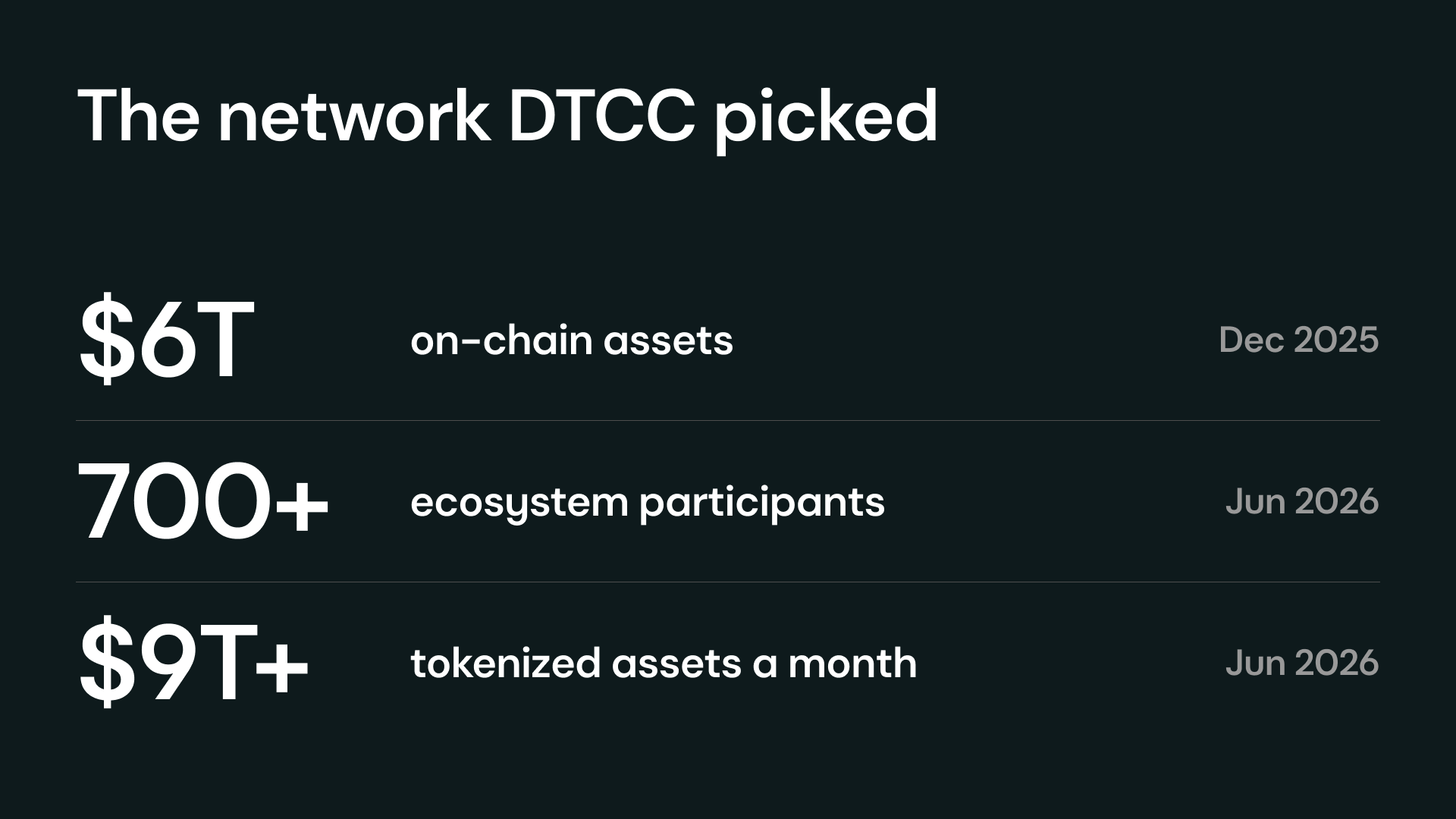
The network carried roughly $6 trillion in on-chain assets as of December 2025, Digital Asset now counts more than 700 ecosystem participants, and Canton reports over $9 trillion in tokenized real-world assets moving across it monthly. Funding has tracked that growth, with $135 million raised in June 2025 and another $355 million in June 2026 led by a16z crypto, alongside BNP Paribas, Goldman Sachs, Citadel Securities, HSBC, CME Ventures and the Abu Dhabi Investment Authority. Nearly half a billion dollars, most of it from the market infrastructure that expects to run on these rails.
DTCC has not gone Canton-exclusive. The July trades ran across both Canton and DTCC's own private Besu network, and DTCC has said its approach is multi-chain. What makes Canton notable is not exclusivity but that when the largest securities depository in the world needed a public network institutions would actually put regulated assets on, Canton is the one carrying them.
Tokenization does not move shares anywhere, because they are already inside DTC and stay there, with Cede & Co. still the registered owner. What changes is the representation, as a row in DTC's ledger becomes a contract on Canton that can move between wallets at any hour without a separate instruction.
Three things define the resulting asset, and all three are intentional. Transfers go only to addresses DTC has registered and screened. DTC keeps the ability to mint, burn or force-transfer in limited circumstances such as correcting errors or servicing corporate actions.
And DTC's off-chain record, a system it calls LedgerScan, remains the official book. DTC told the SEC plainly that these "will not be native tokenized securities that are freely tradeable and transferrable."
So this is not a bearer asset. It is the existing settlement system on better plumbing, with the same institution in the same position it has held since 1973.The rules around all of this are still being written.
On September 17, 2026 the SEC issued what it calls the Innovation Exemption, five years of relief that lets on-chain venues trade tokenized NMS stock through permissioned automated market maker pools without registering as exchanges. The caps are tight, at 75 symbols and a quarter of one percent of daily volume for the largest names, and an issuer can object and block a venue outright. It shares one condition with the DTC service, which is that a tokenized share has to carry the same economic and voting rights as an ordinary one. In both cases the share is the asset and the token is a way of moving it.
The answer is financing rather than trading. US equities are already heading toward near-continuous trading, and tokenization has nothing to do with it. On April 10, 2026 the SEC approved Nasdaq's move to 23 hours a day, five days a week, launching December 6, with NYSE going the same way, and a separate approval in March lets Nasdaq trade tokenized shares on the same order book as traditional ones under the same CUSIP and ticker. Tokenized or not, a share will soon trade nearly around the clock on weekdays through ordinary market structure. The exchanges are getting there on their own, and they are stopping at five days.
The people holding these assets are spread across the world. DTC custodies securities from more than 150 countries and territories, and a firm in Seoul that needs to post US Treasuries at the start of its day is dealing with a New York that went home hours ago. Longer trading hours help with the trade itself, but the collateral and the cash behind it still have to settle, and that has always run on the schedule of whichever market the asset sits in. In January 2026 a group including Euroclear, Euronext, LSEG, Société Générale, Tradeweb and Virtu Financial ran the first multi-asset, multi-currency cross-border intraday repo on Canton, moving European government bonds and US Treasuries against euro and dollar cash on the same network.
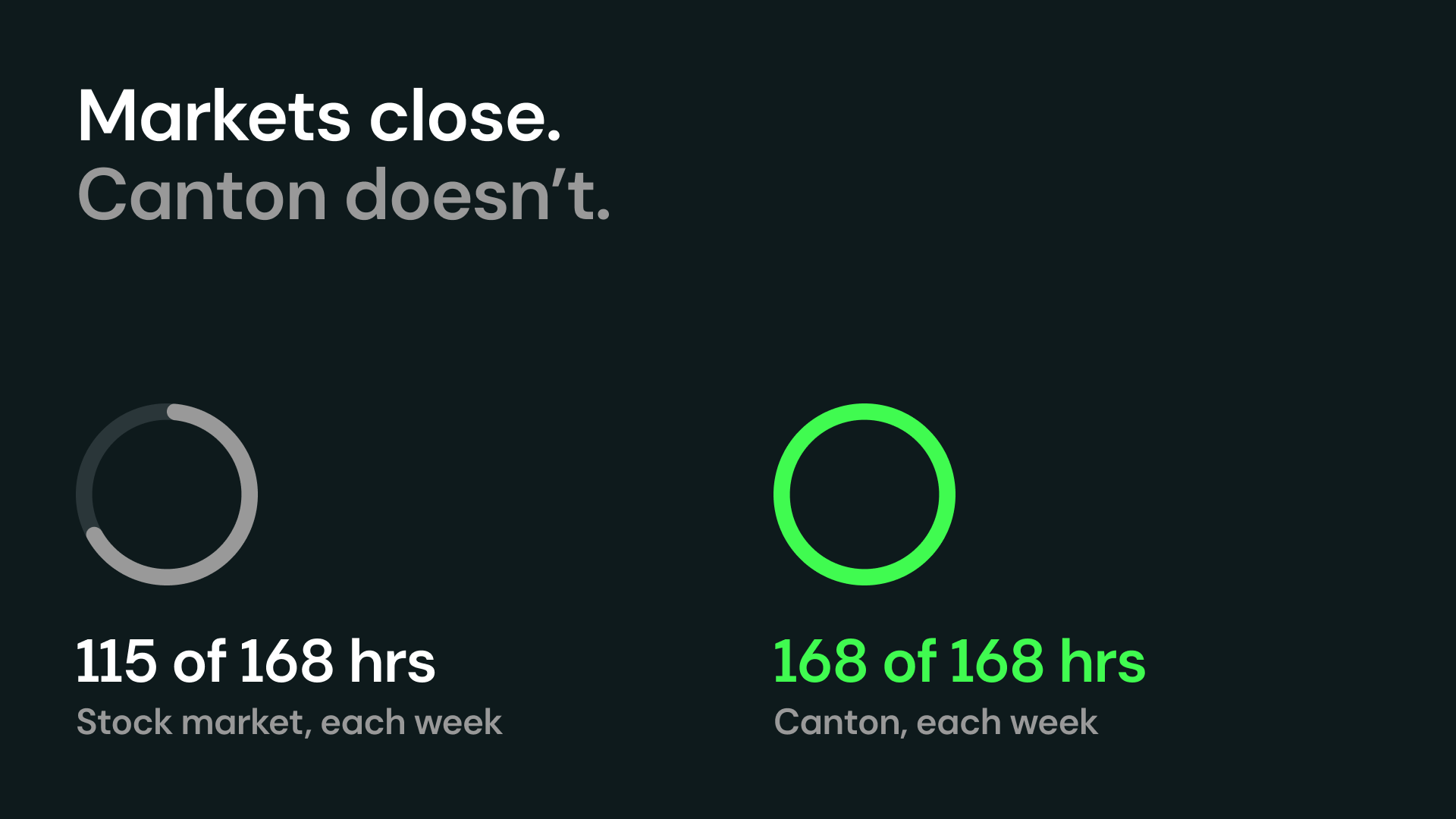
The weekend is the harder problem. Even at 23/5 the market closes Friday evening and does not reopen until Sunday, roughly 49 straight hours. Financing demand does not observe that schedule, and a treasurer who needs to fund a position on a Saturday still waits until Monday. Tokenized collateral fills that gap, because collateral, repo, securities lending and margin all settle on Canton whenever the parties want, atomically, weekends included. An intraday repo of fifteen or twenty minutes becomes possible where one day was the minimum term, which is why the first wave of live transactions was financing rather than retail trading.
Send runs a Canton validator and a consumer wallet that already speaks CIP-56, hosts user parties, and signs with passkeys rather than seed phrases, and it is not a broker, a depository or an exchange. DTCC's model has two tiers, Member Participants who connect directly and End Users who are their clients, and while the participant brings the license and the DTC account, someone still has to turn institutional rails into something a person can use.
Send already ships tokenized stocks on Base, which run on the opposite model of freely tradeable wrappers, 24/7 DEX pricing and an issuer as counterparty. DTC tokens on Canton sit at the other end of that spectrum, carrying the actual entitlement and permissioned transfer, which makes the two complements rather than competitors.
Most people will see nothing at all. The first phase is institutions moving Treasuries between each other to finance positions. What changes is the assumption underneath.
For fifty-three years the ledger that decides who owns American securities has been a private record inside one institution, reachable only through a broker and updated on a schedule set in the 1970s. In October part of it takes a second form, as a programmable asset on a public network.
The rules around it are strict and they should be, but the ledger is open now, and ledgers do not usually close again.
Send builds consumer financial infrastructure on Base and Canton. Nothing here is a statement of partnership with DTCC, Digital Asset, or any firm named above.


We’re building a space where ideas move faster, creativity feels effortless, and every message matters. Your support and feedback help shape the future of how we connect, share, and create—together.


